By Dagmar Schönig. Originally published in Scripophily, the official Journal of the International Bond and Share Society (IBSS), Issue No. 120, December 2022, pp. 16–17. Republished by ScripoTime with permission and with thanks to the IBSS.
This is the third part of a trilogy about the Deutsche Bank written by Dagmar Schönig for HIWEPA's blog. Part I was published in Scripophily magazine No.118, part II appeared in No. 119. Images of certificates courtesy of IBSS member Horst Klophaus.
With the founding of the German Reich after the 1870/71 Franco-Prussian War, Germany created a common currency for the first time: the Mark. Previously, different types of currency circulated in the states in form of guilders or talers, based on different monetary systems. Since the introduction of the Mark, there have been six new currencies in West Germany alone. This history can be illustrated by looking at the shares of Deutsche Bank, which was established in the same year that the German Reich was formed.
1871 to 1919: The Mark
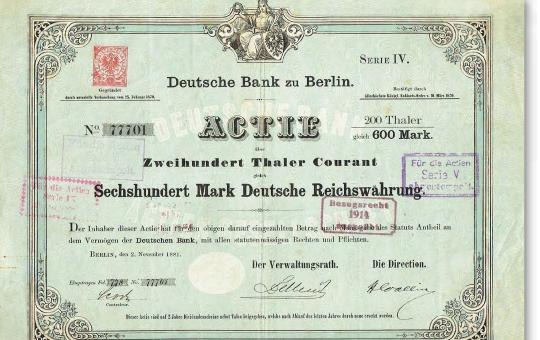
The Mark of the German Empire initially had a gold backing (gold standard) and was therefore also called the “Goldmark.” In 1914, with the outbreak of World War I, the gold coverage was abandoned. The 1881 stock of “Deutsche Bank zu Berlin” still shows the same design as the first shares issued in 1871. It has a nominal value of 600 Marks, which corresponded to 200 (Prussian) “Thalers”.
1919 to 1923: (Paper) Mark
Due to the wartime economy and a lack of precious metal reserves, there was already severe inflation during and especially after World War I, which escalated into hyperinflation in Germany in 1923. The official currency denomination was still the Mark, but to distinguish it from the prewar money backed by precious metals, it was called the “Papiermark.” Since it is an unofficial denomination, no securities have been issued in it.
1923 to 1924: Rentenmark
Starting in November 1923, the new “Rentenmark”, intended as an interim solution, was designed to stop hyperinflation. The exchange ratio was 1 to 1 trillion Papiermarks. The Rentenmark was actually a bearer bond issued by the newly founded Deutsche Rentenbank, whose capital was based on land debts and mortgages (i.e., on the annuity assets “land”). You will also look in vain for the term Rentenmark on historical shares.
1924 to 1948: Reichsmark
From 1924, gold reserves were again sufficient to cover the currency in international monetary transactions. Therefore, the Rentenmark was supplemented with the newly created “Reichsmark” at a ratio of 1:1. The original plan was to replace the Rentenmark completely with it, but in practice this failed. The first Reichsmark banknotes were officially issued starting on August 30, 1924.
The merger of Deutsche Bank with Disconto-Gesellschaft took place in 1929. At that time until the end of World War II, the Reichsmark was the official currency of Germany.
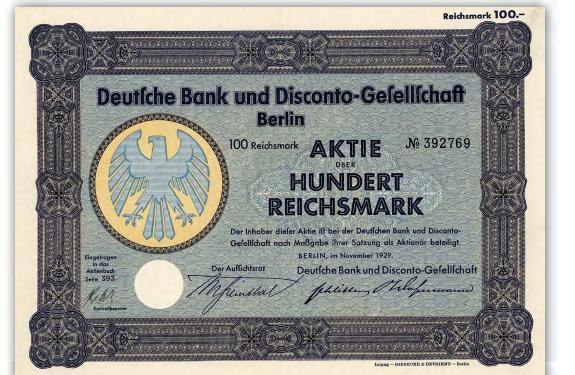
The Deutsche Bank share of 1952 is a curiosity, being issued in Reichsmark, although this currency no longer existed. The paper is in fact a “residual stock”. After the division of the bank following World War II, the “old shares” were replaced by certificates of the new legal entities. Since the expropriated assets in the Eastern part of the country were not included in the new entities, the shareholders of the partial establishments received new shares in the “old bank” denominated in Reichsmarks: the “residual quotas”. It was not until 1983 that Deutsche Bank's residual quotas were finally deleted from the Commercial Register.
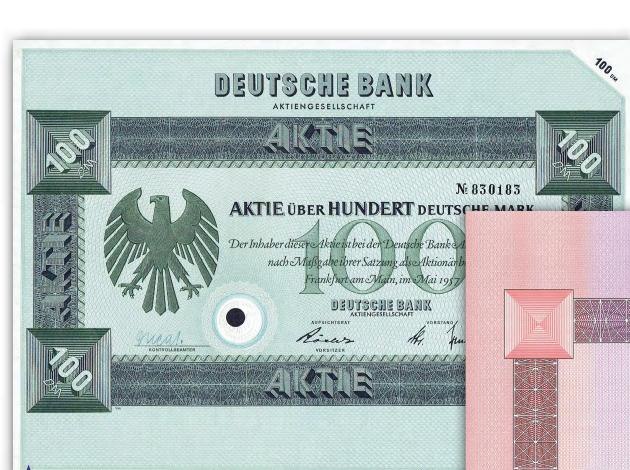
In 1957, the three successor institutions of Deutsche Bank, which had been split up after World War II, merged again. The legal basis to do so had existed since the end of 1956. On May 2, the (new) Deutsche Bank AG was founded with its headquarters in Frankfurt am Main, with backdated effect to January 1, 1957.
An unusual certificate is Deutsche Bank's “Global Share” of one million DM from 1979. Global Shares are collective certificates for multiple individual shares. They simplified the safekeeping and administration of securities but were excluded from exchange trading. As a result, they were mainly reserved for major shareholders wishing to hold their stocks for the long term, or they were used in a transitional phase during capital increases and the issue of new shares.
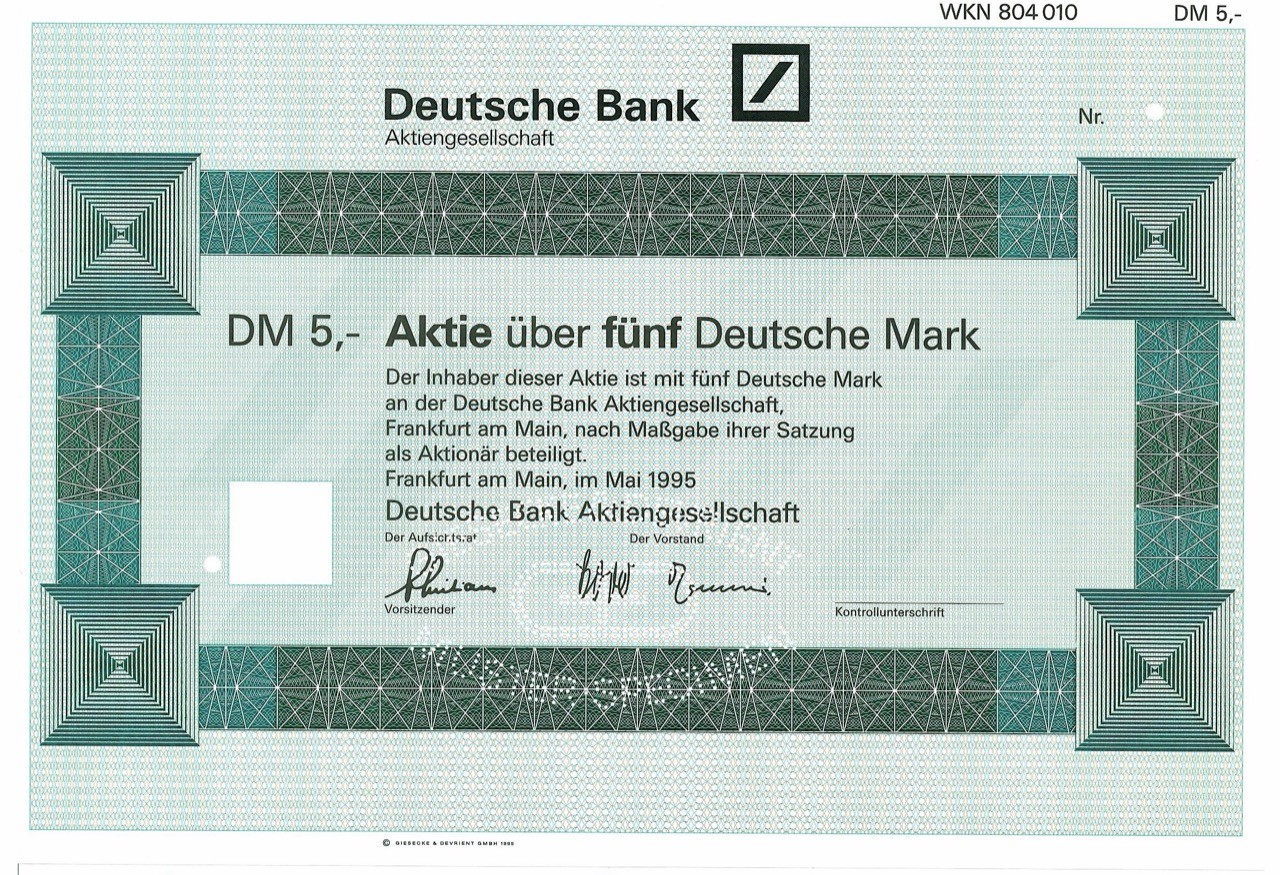
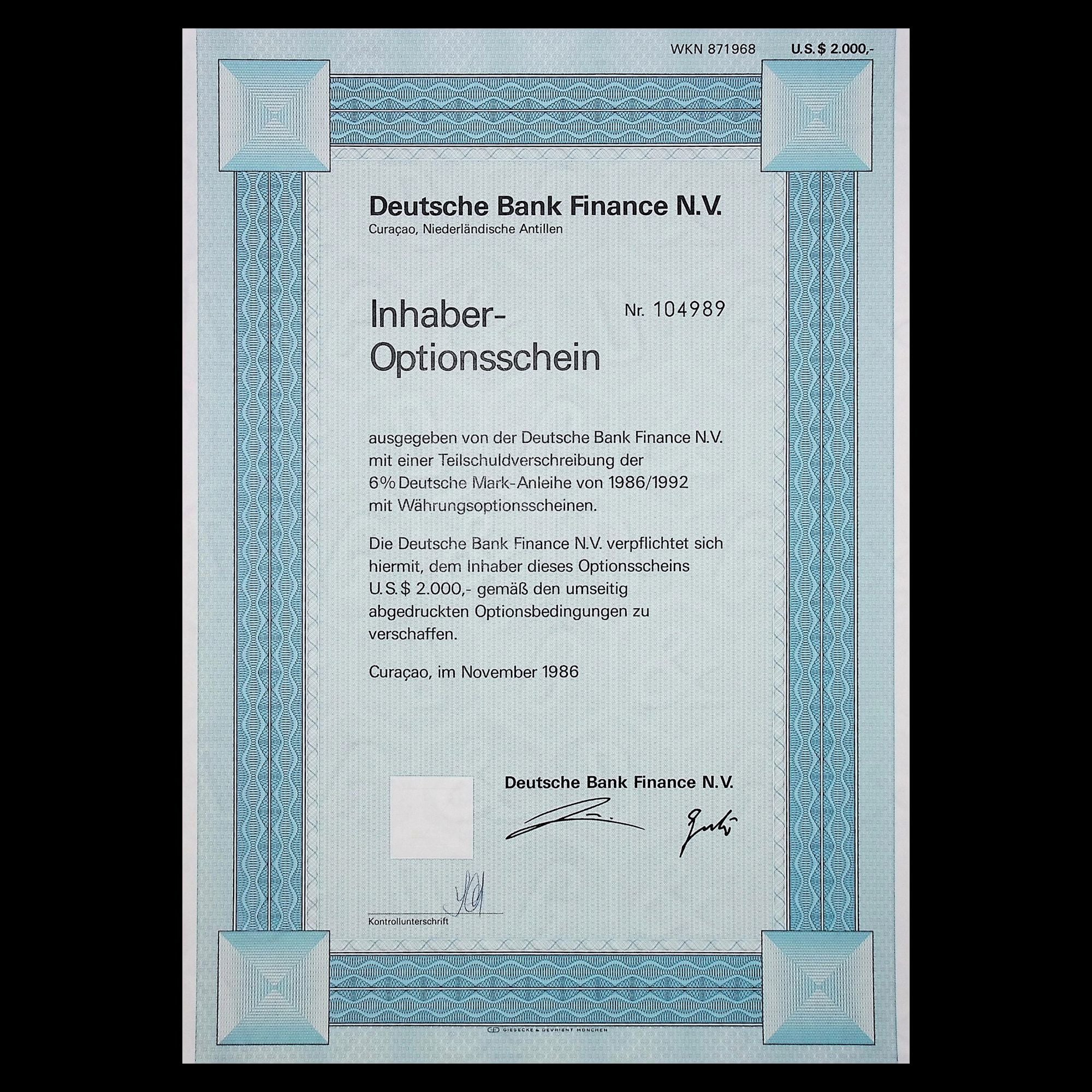
1948 to 1999: Deutsche Mark or D-Mark
From 1944 until the monetary reform of 1948, i.e., even before the end of World War II, the Allies issued the Allied Military Currency (AMC) for occupied territories, which was used in addition to the old Reichsmark in Germany. AMC were also used in other occupied countries. The actual currency reform did not take place until 1948, when the Deutsche Mark was introduced. The exchange ratio to the Reichsmark was set at 1:10 RM. After the founding of the Federal Republic of Germany on May 23, 1949, the Deutsche Mark remained the monetary unit in the West German territory, including West Berlin. In the Soviet Occupation Zone, there was also a currency reform shortly thereafter. Initially, the currency valid in that area was also called “Deutsche Mark”, from 1964 “Mark der Deutschen Notenbank (MDN)”, and from the end of 1967 “Mark (M) der Deutschen Demokratischen Republik (Mark of the GDR)”.
From 1999/2002: Euro (€)
The euro, the currency in circulation in Germany today, was introduced on January 1, 1999 as so-called book money. Since January 1, 2002, the Euro has also been in use as cash. It was converted at a ratio of 1:1.95583 DM.
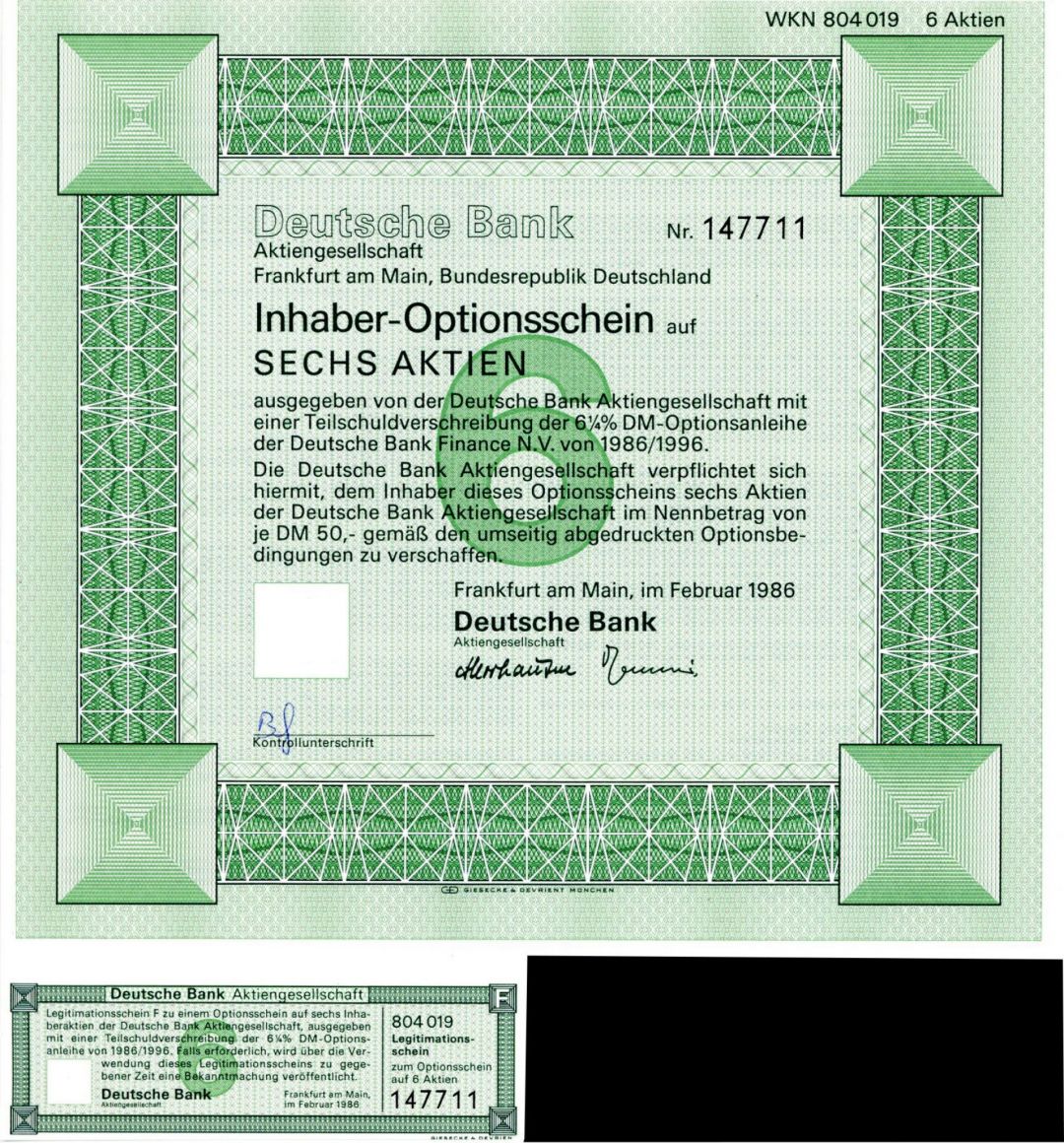
The last Deutsche Bank Share Certificate is not denominated in any currency. Since 1998, so-called “no-par-value shares” have been allowed in Germany. The idea behind the unit stock is that each share represents an equal portion of the Company's share capital available for issuance. The total number of all shares constitutes the total share capital. The proportion of capital stock per share is therefore calculated by simple division.
Join the discussion
Financial History Institute Editorial invitation
What do you think? Share your perspective, questions or historical insights below. We welcome a thoughtful discussion.
Comments are reviewed before appearing. Your name and comment will be public once approved.