By Max Hensley. Originally published in Scripophily, the official Journal of the International Bond and Share Society (IBSS), Issue No. 120, December 2022, pp. 23–27. Republished by ScripoTime with permission and with thanks to the IBSS.
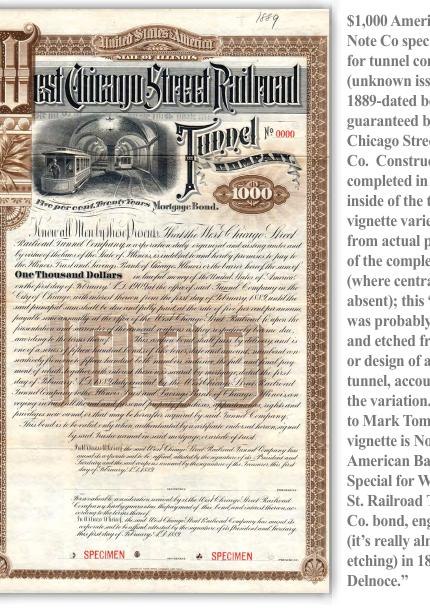
For a few years in the 1970s I lived in Chicago. I was intrigued by an abandoned railroad tunnel just north of Union Station that went under the Chicago River. It clearly was not part of the subway system and the grade (about 10%) was too steep to have been a normal railroad tunnel. So, imagine my surprise when Archives International Auctions LLC offered the bond in Figure 1 (they have offered one more of these since). Could this be the bond that financed my mystery tunnel in Chicago?
First, some clarity. It was not the West…Chicago Street Railroad. It was the West Chicago…Street Railroad. It didn't run on a street called Chicago Street. It ran on Van Buren Street for the most part and connected downtown, now the “loop”, with the western third of Chicago. In the beginning it was a horse-drawn trolley line, then a cable powered line, which fairly quickly gave way to overhead electric propulsion, finally being superseded by buses and subway. It was one of many projects by transportation entrepreneur Charles Yerkes.
Charles T Yerkes, Jr.
Yerkes' (1837-1905) father was a Quaker banker expelled from the religion for marrying Charles' non-Quaker stepmother. Young Yerkes started his business career in 1854 as a clerk in a Philadelphia grain brokerage, and with the help of his father, formed a securities brokerage within five years. Business prospered, particularly when Charles formed close associations with Philadelphia's corrupt treasurer, married well, and began dealing in Philadelphia city securities.
Charles had become dependent upon short term loans from a corrupt Philadelphia city treasurer by the late 1860's. Charles had taken a position in the Pennsylvania Railroad that depended upon the price of its stock increasing. The night before this venture was to close, the Great Chicago Fire of 1871 induced a panic that ruined him. He and the city treasurer were convicted of fraud and sent to the notorious (and still standing) Eastern State Penitentiary in Philadelphia.
After serving only seven months of a 33-month sentence, Yerkes was released and began to rebuild his career. He was attracted to street railroads and moved to Chicago in 1881 to pursue opportunities there.
The West Chicago Street Railroad Co
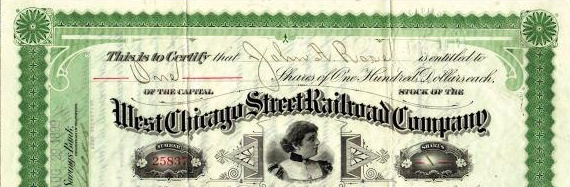
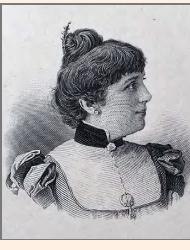
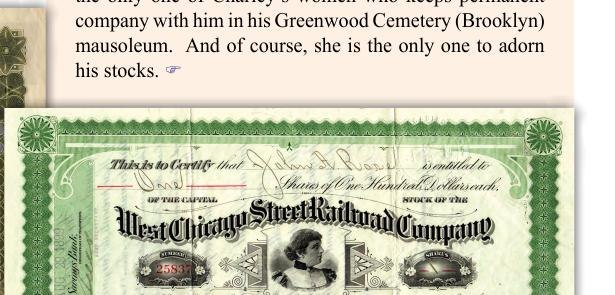
Indeed, the woman in the vignette on the West Chicago Street Railroad certificates is Yerkes' second wife Mary Adelaide Moore. Charles dumped his devoted first wife of 22 years Susanna so he could marry his much younger, beautiful mistress Mary Adelaide, procuring a “quickie” Dakota Territory divorce to do so. He and Mary ended up in Chicago in 1881 where Charles's spectacular career in cable cars got its start. The vignette image is from a die proof courtesy of Mark Tomasko. It is labelled “Mrs. C.T. Yerkes” and was engraved by the Western Bank Note Co Chicago. According to Mark, “they had to modify the portrait to fit on the stock certificate, moving the hair bun and shortening the (presumably white) blouse part of the dress. There are no engraving records for Western and I have no information on who did the portrait.”
Yerkes and associates bought the West Chicago lines by selling bonds and issuing stock to he and his collaborators, thereby buying the line with none of their own money. He and his friends made cash money on the deal by forming United States Construction Co (no scripophily known) to upgrade the horse cars to cable and making the West Chicago company pay for it - at grossly inflated prices that went back to him and his friends as construction company dividends. If this sounds familiar it was an old trick in railroad development – starting with the Union Pacific.
Between 1889 and 1893 Yerkes converted the West Side lines to cable and those, in turn, were converted 1892–1896 to overhead electric, including the remaining horse car lines, with a few minor exceptions. By 1890 Yerkes' mileage stood at 150 miles. By 1897 it had increased to 203 miles, of which 31 miles were operated by cable power, seven by horse power and 166 by overhead electric. Yerkes' mass transit operation had exploded along with the growth of Chicago.
The West Chicago Street Railroad Tunnel
One of the improvements Yerkes had promised to deliver the city was another tunnel connecting the downtown area of Chicago with its rapidly growing West Side. Tunnels were used because street car traffic was seriously disrupted by the frequent opening and closing of the bridges for river boats. This was the last of the three tunnels built under the Chicago River.
The Tunnel was to be used exclusively under a 999 yr. lease financed by a toll on every car passing through the tunnel. $1.8 million in Tunnel capital stock was held in trust for benefit of the West Chicago Street Railroad. In 1899 these properties and a number of Chicago's other street railroads were merged into the Chicago Consolidated Traction Co [footnote 5: Economist Weekly Investors Manual Vol. 21 p. 11 May 6 1899. Despite the merger, the West Chicago Street Railroad Co was alive in 1902 and issuing stock, as confirmed by the share certificate depicted above.]. This company went into receivership in 1903.
In 1905 all the Chicago River tunnels were declared to be an obstruction to navigation of the Chicago River (they were too shallow). The cable line made its last run in 1906 and the Tunnel was sold in foreclosure in 1908.
Yerkes after Chicago
Yerkes' grasp turned out to be transcontinental: he brought about the consolidation of the London municipal railway system after decades of existence as a hodgepodge of competing companies created by Parliamentary intrigues. Yerkes' genius for understanding the linchpins of any railroad system that relied on government franchises for its existence was equally effective in England as it was in Philadelphia and then Chicago. His final act in the mass transit railroad business was the London Underground.
But he died in New York of nephritis on December 29, 1905 - before he could see his London project through to completion.
Charles Yerkes indeed demonstrated that there are at least second acts in life - given enough will and talent. The other way was shown by Yerkes' Philadelphia Treasurer co-conspirator, who had entered prison with him in 1871. He had died penniless many years before Charles T. Yerkes.
Join the discussion
Financial History Institute Editorial invitation
What do you think? Share your perspective, questions or historical insights below. We welcome a thoughtful discussion.
Comments are reviewed before appearing. Your name and comment will be public once approved.