By Gordon Bond, as supplemented by Max Hensley, with grateful appreciation to www.GardenStateLegacy.com. Originally published in Scripophily, the official Journal of the International Bond and Share Society (IBSS), Issue No. 116, August 2021, pp. 22–26. Republished by ScripoTime with permission and with thanks to the IBSS.
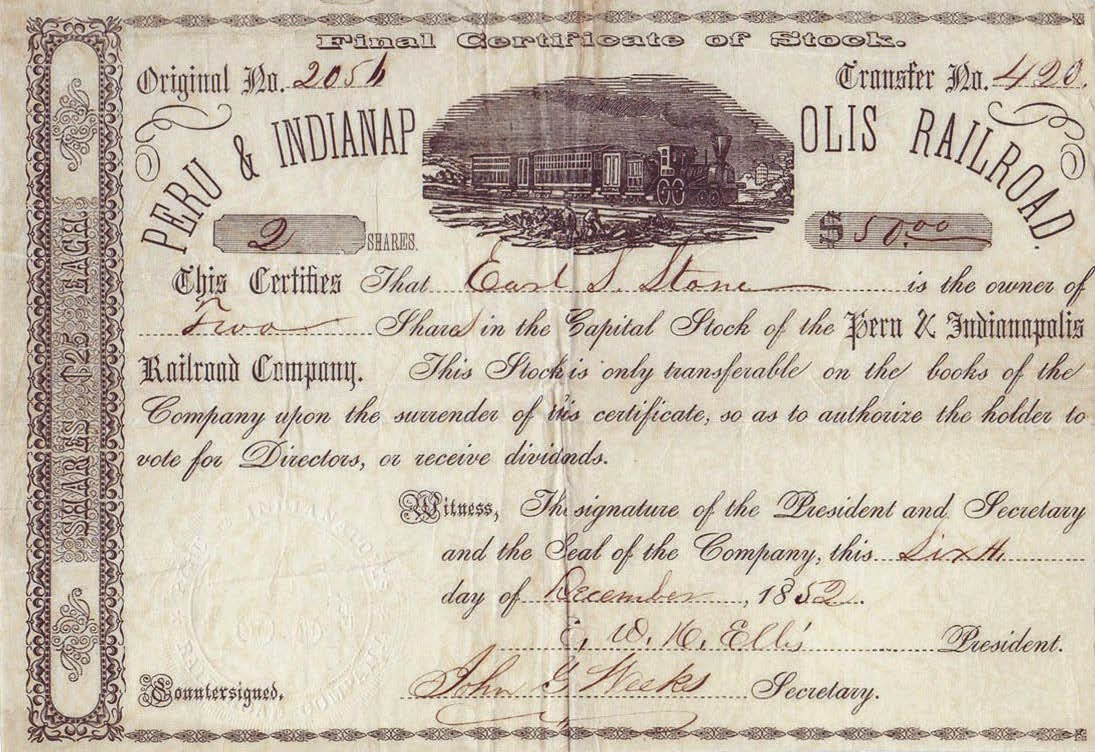
A Google search on 'strange locomotives' turns up page after page of oddball inventions built to pull a train easier, faster or cheaper than the competition — some born of specialized needs, some the product of amateur dreamers, and at least one, which made a brief appearance in 1897 on a South New Jersey line, that may have been willfully dubious. The so-called 'Holman locomotive' was not an engine so much as an appliance attached to existing steam locomotives, making tall promises to potential investors. It was the brainchild of William J. Holman, born June 2, 1819 in Richmond, Indiana, who by his death in 1904 could claim to have been president and chief constructor of the Peru & Indianapolis Railway Co (said to be the first line built in the state), to have discovered the South Park gold fields of Colorado around 1855, and to have established the Mount Diablo meridian in California for the US government. His obituary noted that in his later years he had 'devoted most of his time to perfecting the Holman locomotive speeding truck.'
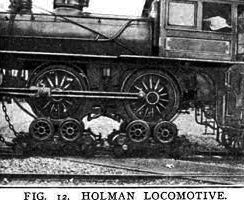
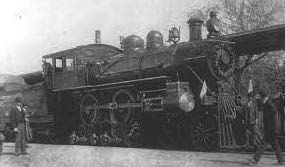
In 1894 the Soo Line leased a standard Baldwin steam locomotive to Holman for trials; he declared them a success and generated enough favorable press in the US and Europe to suggest this was the future of railroading, and began selling stock in the Holman Locomotive Speeding Truck Co. By 1897 he was preparing another demonstration to woo investors, this time on a branch of the Reading Railroad then known as the Atlantic City Railroad, running from Winslow Junction to Cape May, New Jersey. Le Van witnessed 'an ordinary Baldwin class 8-34 C type locomotive, raised thirty-five inches from the rails by the Holman friction truck under each pair of drivers,' running the 54.1 miles from Winslow Junction to Cape May in 56.5 minutes — an average of 57½ mph, with some short stretches, by Le Van's estimate from passing telegraph poles, at 70 or 75 mph, though some passengers claimed a wildly improbable 120 mph. A further test between Cape May and Cape May Courthouse covered a mile in as little as 41 seconds (87.5 mph). Le Van, while conceding the track was not ideal for high speed, remained unconvinced by the overall claims: no means had been provided to measure the power needed to overcome the added trucks' friction, no horsepower indicator was fitted, and fuel and water consumption went unrecorded.
Mechanical engineers and railroad men saw quickly that the laws of physics made the claims dubious. 'It would be a waste of space to criticise such a thing,' editorialized the professional journal Industry after Holman's earlier 1894 claims, '...The editor must know it is clotted nonsense, impossible on mechanical grounds, and a freak on all other grounds. A portrait of the inventor would have more interest.' Since there were no speedometers on steam locomotives, speed could only be timed against trackside mile-markers or telegraph poles with a pocket watch — an inherently imprecise method that left room for stretched or outright false claims; the first US locomotive officially confirmed to top 100 mph had done so only five years before Holman's Cape May test, in 1892, near Batavia, New York.
Many in railroading and engineering suspected the whole scheme was a stock swindle dressed up as an invention. 'The parties exploiting the Holman locomotive speeding truck are advertising the stock of their company in numerous newspapers,' wrote Railway and Locomotive Engineering, 'claiming that the invention is certain to come rapidly into general use... When we first heard of the Holman locomotive speeding truck, we supposed that it was the invention of some harmless crank who did not understand the elementary principles of mechanics, but now believe that it has been, since its inception, an ostentatious machine designed to allure unwary capitalists into an investment that will be of as much real value as the throwing of gold coin over Niagara Falls.' American Engineer and Railroad Journal was equally blunt, noting stock offered at $50 a share against a claimed $10,000,000 capitalization and calling the machine 'dangerous at high speed,' wasteful of coal, expensive to build and maintain, and without 'one redeeming feature that we can discover.' Machinery magazine wondered why Philadelphia — where the company had its headquarters — seemed to attract more than its share of stock schemes, this being 'another attempt to gain power' by mounting drivers on auxiliary trucks.
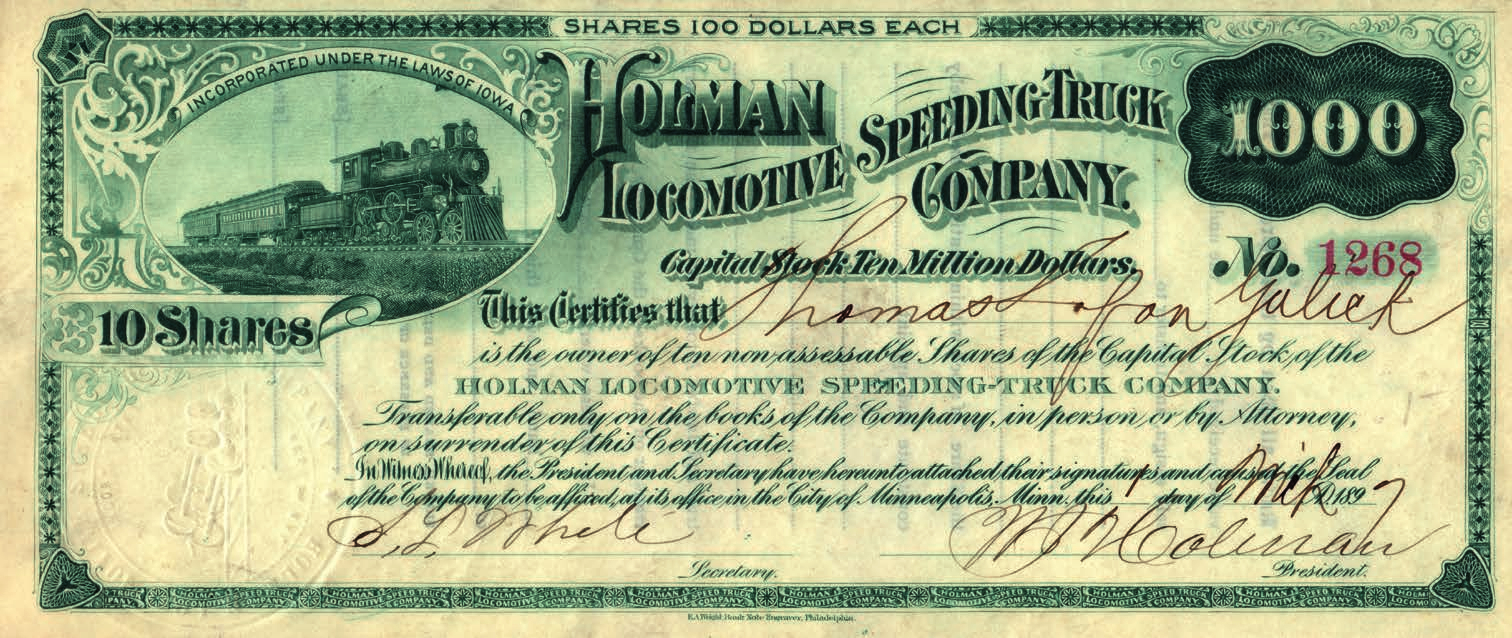
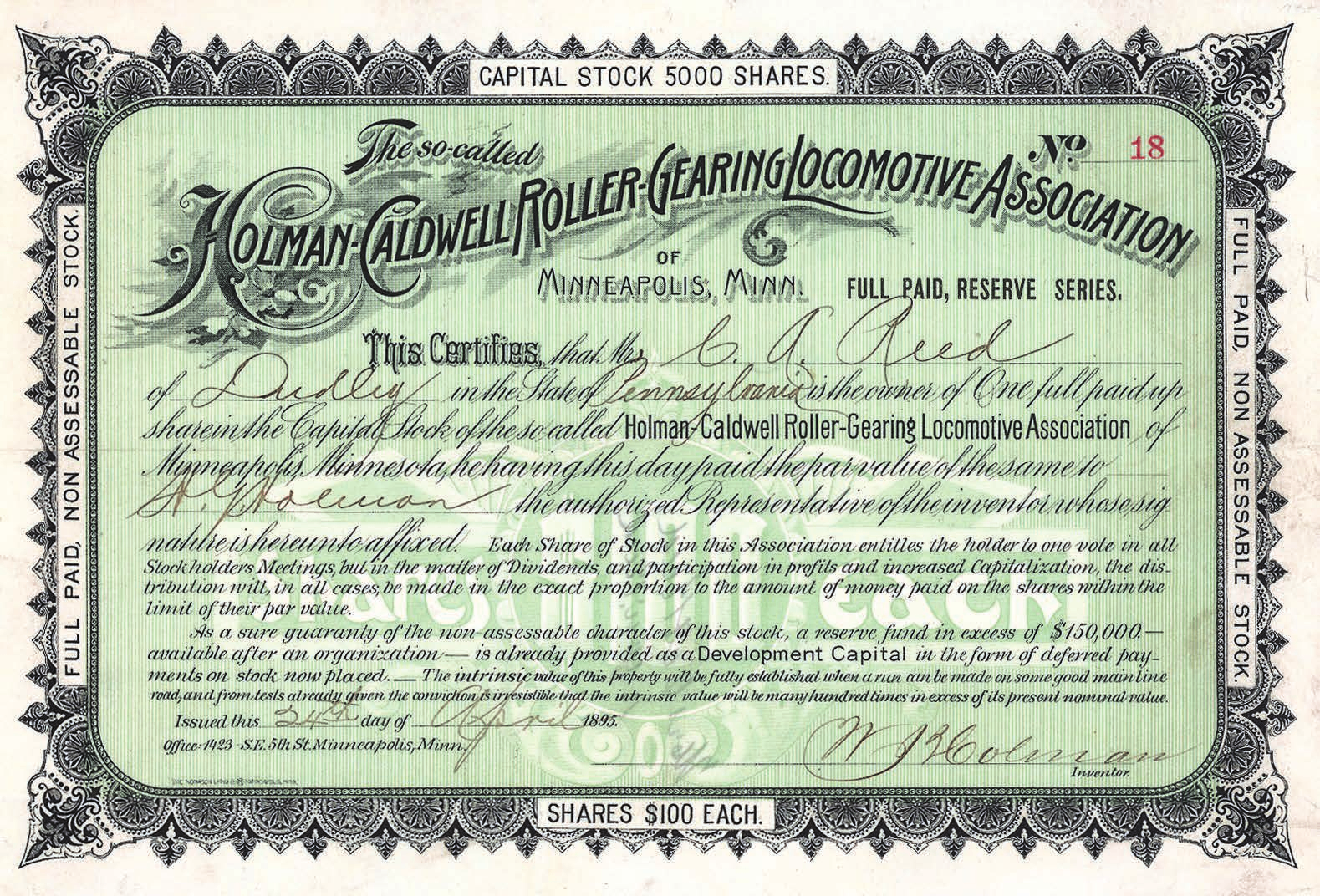
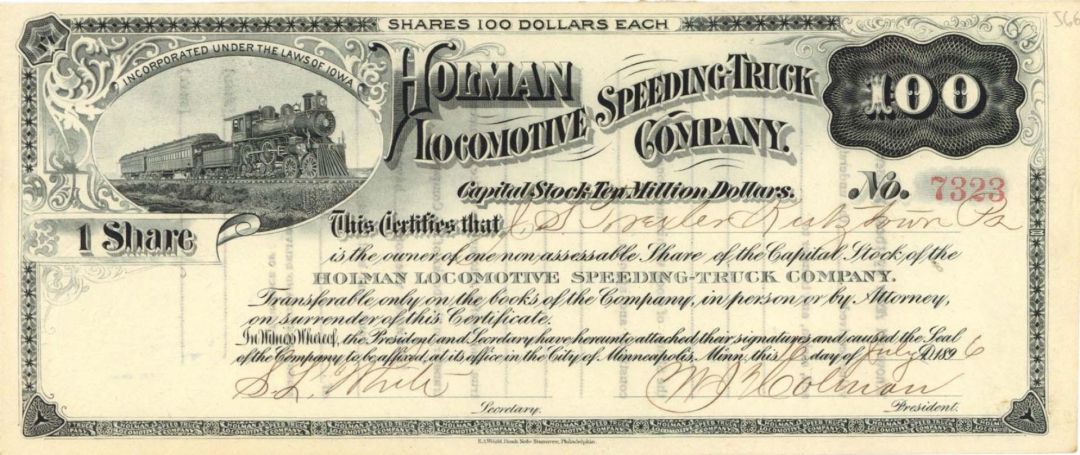
Regarding the scripophily of the Holman Locomotive Speeding Truck Co: preprinted black 1-share certificates are widely available (Coxrail.com lists 41 of them), but the 10-share certificate is harder to find (13 are known, issued between 1896 and 1901), and there is a unique 100-share certificate (no. 77) — Terry Cox would appreciate seeing scans of any others. The number in the upper right corner is not the share count but the par value of the shares at $100 each, so the illustrated 10-share certificate carries a prominent '1000.' The certificates were steel-plate engraved by the E.A. Wright Bank Note Co of Philadelphia in a design meant to evoke a banknote; none of the stocks seen so far have been cancelled. A separate, unique certificate in the Holman-Caldwell Roller-Gearing Locomotive Association of Minneapolis (Coxrail HOL-610-S-20), signed by 'W. Holman,' hints that H.D. Holman — who resided in Minneapolis — may have organized a second entity to promote the same scheme.
Join the discussion
Financial History Institute Editorial invitation
What do you think? Share your perspective, questions or historical insights below. We welcome a thoughtful discussion.
Comments are reviewed before appearing. Your name and comment will be public once approved.